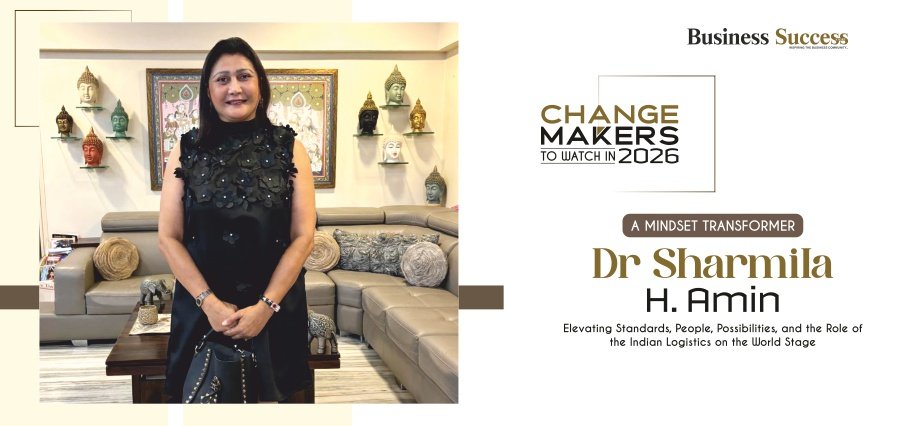
For modern businesses, especially in the field of logistics, supply chain, freight forwarding, and shipping, mindset matters more than mere tech intelligence. Because when the mindset is not flexible, then it is more prone to rejecting change always, and thus, maintaining the status quo.
That is why when she began her professional journey, the biggest status quo Dr Sharmila H. Amin has been committed to breaking is the deeply entrenched belief that logistics must operate reactively rather than intelligently and proactively. “For decades, our industry has accepted fragmentation, manual decision-making, and slow cross-border coordination as ‘normal,” she informs.
Eliminating the Flaw
What allowed her to see the flaw was a simple insight: data is already available to make logistics predictive — “it’s the mindset that isn’t.”
Where others saw complexity, she saw an opportunity to create clarity, speed, and resilience through digital transparency and integrated planning.
And on that basic principle began Dr Sharmila’s mission as the Chairperson and Member Board of Globe Forwarding Agencies India Pvt Ltd . As a part of it, in 2025, the company is executing its most ambitious project yet: a fully integrated multimodal control tower for South Asia, powered by real-time data, AI-enabled forecasting, and predictive compliance checks.
This initiative will redefine the market by shifting logistics from being shipment-led to ecosystem-led, creating unprecedented visibility and reliability for heavy-lift, project cargo, and end-to-end industrial movements across India and beyond, informs Dr Sharmila.
A Unique Success Metric
When asked what the measure of this success is based on, her unique metric for change that goes beyond traditional revenue or market share figures, Dr Sharmila replies that it is ‘friction eliminated per project.’ This includes reduced downtime, fewer handover lapses, zero-touch documentation, and faster approvals across stakeholders.
She explains it further: When friction drops, velocity increases — and when velocity increases, value compounds. Revenue follows, but transformation shows up first in the disappearance of inefficiencies.
Envisioning Logistics in 2030
Going ahead, she tries to predict the state of the logistics industry in 2030, if her vision succeeds completely. By then, logistics will no longer be a silent back-end function. It will be a strategic advantage and a competitive differentiator, she states.
The landscape will feature:
✨ Seamless digital corridors across ports, terminals, and inland hubs.
✨ Predictive planning as the norm, not the exception.
✨ Carbon-aware routing and greener multimodal configurations.
✨ Operators working in ecosystems rather than silos.
✨ India positioned as a logistics launchpad for global industrial champions.
“In this future, reliability is engineered, not hoped for,” she believes.
The Conviction and the Courage
Now, leading such a radical change requires courage. When asked about the source of her conviction to pursue her vision when internal resistance or external skepticism is at its highest, Dr Sharmila reveals that her conviction comes from two sources:
🔹 The long-term trust of customers who depend on us for mission-critical projects.
🔹 The teams who believe in a better way of working, even when the path is steep.
“When skepticism rises, I remind myself that every major shift in logistics—containerization, digital tracking, multimodal integration—began with people who refused to settle for ‘how things are.”
Innovation as a Daily Habit
Dr Sharmila has structured her team and culture to ensure that “failure” is treated as data for continuous reinvention, rather than a deterrent to bold experimentation. She insists that it is a culture that rewards bold thinking and structured experimentation. Every major initiative follows a simple rule: “If it works, we scale it. If it doesn’t, we document the learning and refine it.”
Teams are encouraged to question conventions, propose rapid pilots, and use data to iterate — not justify. This has created an environment where innovation is not a special event but a daily habit.
A Holistically Evolving Ecosystem
Furthermore, Dr Sharmila is actively engaging and challenging established competitors, regulators, or even customers to ensure the entire ecosystem adapts to the change she is driving. “I believe real disruption only happens when the ecosystem evolves together.”
They are actively:
✔ Collaborate with regulators to co-design simpler, digital-first approval processes.
✔ Challenge competitors by setting higher benchmarks for transparency and speed.
✔ Educate customers on the value of long-horizon planning and intelligent routing.
By raising expectations across all fronts, Globe Forwarding Agencies accelerates the pace at which the industry upgrades itself.
Elevating Her Legacy
Finally, Dr Sharmila hopes that in the future when historians will look back at this transformative period, she hopes them to describe her leadership and impact in one verb. “And if I had to choose that verb, it would be: ‘Elevate.’ I aim to elevate standards, elevate people, elevate possibilities, and elevate the role of Indian logistics on the world stage. If history remembers me for elevating an entire sector — I will consider that impact meaningful.”