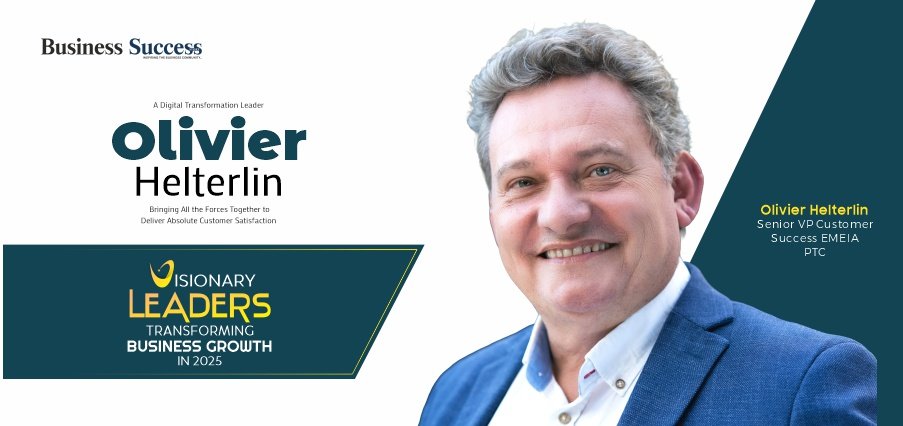
The current world runs on the uninterrupted engine of globalization. A globe where all the businesses have their busiest people demanding constant connection. A real-time link provided by the fabric of concurrent reality. An ever-evolving stream of authenticity woven with digital threads. Creating, bonding, monitoring, strengthening, and solidifying these digital threads for the centre of this activity, that is, the customers, are visionary leaders like Olivier Helterlin, who are transforming business growth in 2025.
In Olivier’s case, being a Senior VP Customer Success EMEIA at PTC means not only creating this real-time digital reality and keeping it constantly functioning all the time, but it also means that he and his company must be creating value for the entire global ecosystem and its every stakeholder, including the most important one, the customer.
As he puts it, “How to make this sentence a reality and not a buzzword? This is how I could summarize PTC endeavour, my whole career journey, and especially my time with PTC.”
Olivier joined PTC in the Professional Services area, moved to a sales leadership role during the next five years, and then took over his present role two years ago, governing the whole after-sales motion of PTC across EMEIA, in order to maximize business value for its customers by “enabling digital transformation across the enterprise.”
Customer Value & The Subscription Economy
Olivier says, at PTC, they believe Customers don’t buy software. They buy a business value coming out of the solution and the way it has been implemented (on time, on quality, adopted). Managing value as an outcome means that value is not some $ on a presales slide deck, but an end-to-end methodology binding presales value roadmap exercise, how to define a to be model of business processes based on PTC best practices; implementation approach defining and executing a project starting with requirements based on business best practices; and Customer Success Managers (CSMs) tracking the value realized by customers. This means using across all Customer Success a consistent baseline of business best practices, by business discipline (engineering, manufacturing, services), by vertical, and the metrics enabling the modeling of savings and tracking their achievement.
The Retention Equation
In a subscription-based model, Customer Success drives revenue. The main driver to reach this goal is people. Enabling people, bringing them together under one single goal: grow customer satisfaction. In lieu of having services fighting for margin, presales for new bookings, and CSMs working downstream to avoid churn. An outstanding retention performance comes first with leadership across disciplines, accountability, and speed in making the right decisions that will grow customer satisfaction. Tooling comes next in order to provide the right support to the teams, ease their life, give them access to data, and create an outstanding customer database that AI can leverage to better anticipate actions.
“Telemetry, customer surveys, and AI are key enablers to take preventive measures and ensure a smooth experience for our customers.”
Strategic Leadership in EMEIA
*Navigating Diversity: The EMEIA region is a patchwork of regulatory, economic, and cultural environments. The strategy to cope with this is double: “Organize our go to market, including CSMs by customer strata, from strategic to transactional, setting up models accordingly from high touch to low touch; ensure a local presence, in local language, in all regions.” The resulting cultural diversity is fostering customers’ intimacy and generating a colourful blend of talents that brings value in itself, sharing different points of view on the same issue, and various valuable ways to resolve it.
*Talent and Domain Expertise: PTC’s solutions are highly technical, and we need to develop talents that understand this technicality and who possess the rare blend of industrial domain expertise and commercial relationship skills needed to manage C-suite relationships. CSMs can be young talents, industry specialists, or come from other software vendors. They all subscribe to a strong technical enablement course, and then are part of a career path where, in the ultimate level, they are accountable for a strategic customer and manage executive relationships hand in hand with the sales account manager. PTC also offers bridges to other types of roles that broaden the career opportunities for CSMs.
*Closed-Loop Feedback: PTC has put in place a “Voice of the Customer” department that orchestrates the customer feedback loop via a yearly NPS survey, but also focuses interviews upon key customer events such as go-lives, new won opportunities, or lost opportunities. This amount of data is gathered and shared so we can improve customer experience. In addition to that, “product segment hubs” ensure the product feedback loop with our R&D, in order to get customer feedback on the products, prioritize enhancement requests or new features, and amend the product roadmap accordingly.
Technology, Transformation, and Future Growth
*PTC is a leader in End-to-End Product management: from CAD authoring to Application Lifecycle Management (ALM = embedded Software Lifecycle management), Product Lifecycle Management (PLM), and Services Lifecycle Management (SLM). This value proposal is enhanced by offering these technologies as SaaS, to reduce TCO and gain flexibility and speed, and adding on top “PTC proof” AI agents means delivering the power of AI to get value out of the huge product database created with PTC products, while ensuring full data security and consistency. Olivier says, “We call this full model Intelligent PLM ‘iPLM.” As Olivier states, “this holistic approach embodies our vision of the intelligent product lifecycle.” How to manage the clearest and most immediate return on investment becomes a key trigger for business expansion?
*Enabling this relies on several best practices: value based selling, i.e., proposing a target business value resulting from as-is and to-be processes analysis; deliver based on this value assessment, using implementation templates that ensure the usage of technical and methodologic implementation best practices, by PTC and by PTC partners; lead a continuous partner enablement effort while measuring partners’ certifications; not forget adoption and Organizational Change Management (OCM). Most of the product failures are related to a bad involvement of the business users. To help them understand the goal of the transformation. “We understand well and are taking into account their challenges and potential blocking points.” PTC has implemented an OCM Practice to proactively propose such an approach to customers, by vertical, and enable partners accordingly.
Scaling Digital Transformation
Successful implementations and achieved value, as well, mean not getting stuck in pilots and having a solid plan to scale up. “Our basic principle to achieve this is generally to deliver the first phase of a new project primely, until first go live is achieved, and then hand over to a certified partner who is the best in place to ensure full deployment and integration.” The other trigger is on CSMs to organize upfront the right three-level governance model: operational (project weekly follow-up), tactical (management catch-up on roadmap, risks, and value achievement), and strategic (executive review of holding the promises of the partnership). Making this truly operational is not easy, but buy-in and engagement of the company’s management is the only way to develop a joint program and scale up.
Another trigger worth mentioning is the native openness of PTC technologies, easing integration with third-party solutions. What industrials require is business process transformation, for instance, ‘Configure to Order’. This end-to-end process covers solutions like ERP that are not within the PTC portfolio. So this genuine openness approach is a very good starting point, avoiding the trap of creating a huge and complex technological silo.
Simplifying Complexity
The convergence of these products across the digital thread must deliver a positive user experience by the end, with intuitive access to data and systems. PTC proposes a set of ‘Apps’ that continue to evolve and simplify the access to the right data and function for a given user, across the digital chain, CAD, ALM, PLM, SLM, and third-party solutions like ERP, MES. This kind of approach is well featured in the MBDA story, highlighting how this fosters R&D acceleration and streamlines collaboration across departments. https://www.ptc.com/en/industries/aerospace-and-defense
The Next Manufacturing Era
How is Customer Success preparing the EMEIA industrial base—particularly in legacy manufacturing sectors—for the inevitable shift toward Industry 5.0 principles (human-machine collaboration, sustainability, resilience) is a crucial question, feels Olivier. In other words, he adds that innovation is key, is faster than ever, and is not only a question of R&D. Having the full customer success actors growing towards Industry 5.0 is key. “For that purpose, we are using a pragmatic solution: we have created a dummy company, using the entire PTC portfolio, and constantly evolving towards the latest innovations.” This is both a knowledge base where field professionals (CSMs, services…) integrate feedback, concrete examples found in their daily job, and an enablement support to keep the team up to speed, with regular ‘masterclasses’ being delivered and using this framework.
Beyond the P&L
A personal non-financial metric, which you can call a guiding principle, defines Olivier’s success as a Visionary Leader and his impact on the EMEIA industrial community. The core non-financial metric used, says Olivier, is, of course, customer Net Promoter Score (NPS), which provides an honest qualitative feedback on customer satisfaction. “The comments coming with such a yearly survey are providing golden recommendations that we must apply and anticipate next steps in order to stay ahead of customers’ expectations.”
Another key metric is their AI readiness, “Which means our true integration of AI technology into our daily processes in order to gain productivity and speed.” AI will not replace CSMs, but must enable them to gain speed in gathering various data on customers and take action on that. Same on the services side, this opens a new era of accelerated requirements management, automated testing, and performance monitoring.
Last but not least, people’s feedback coming out of a focused survey is always key. From the consistency and motivation of the team comes the performance towards the customers.
Advice for Emerging Leaders
The single most important mindset shift Olivier advises young leaders to adopt to thrive in the new, value-driven subscription economy, where customer retention is the ultimate growth lever, is simple: “Be a leader! Boots on the ground! Be transformative!”
What does it mean? Olivier explains: “First of all, we should not mix up control, management, and leadership. Those three qualities are required, but they do not mean the same.” Control means you have control over your business, operating rhythm, KPIs, and dashboards to constantly get a 360° view of the business, in order to make the right decisions at the right time. In a context of economic pressure, within US companies measured quarterly, many directors and above fight to reach a good level of control and stop there. Being in control is a mandatory foundation, but it’s not enough. Being a manager means you get to know who your people are, what their high and low lights are, what their aspirations are, coach them to improve and evolve, and make fair people decisions. Then leadership means that, on top, you are able, in the context of your mission, region-wise, to instill the company strategy with your words and your style. This is to provide sense and motivation to your teams, customers, and partners.
Boots on the ground simply means: stay in touch with reality, with customers. Be involved with customer operations for the good (new engagements) and the bad (escalations). That enables you to continue to learn and be credible for your full ecosystem.
Transformative means you should drive the business with execution in one hand and transformation in the other: adjust processes, systems, invent new customer approaches, and be creative. Delivering outstanding execution is not enough and can only be sustainable in the long run without a permanent, transformative behavior to move your organization to the next level. The companies that make products the world relies on rely on PTC. Because of a unique set of solutions. Because of an outstanding Customer Success approach to truly deliver the value promised, insists Olivier, while concluding.
For further information and assistance, directly connect with Olivier Helterlin via phone: +33616991460 or email: ohelterlin@ptc.com.