What makes a leader an asset in an organization?
It is rarely the depth of technical knowledge alone. The leaders moving the needle are the ones who can read where technology is heading, translate that foresight into business value, and connect the right strategy to execute it. As the business landscape shifts and technology evolves, businesses require people who combine systematic thinking, business judgment, and the ability to nurture talent rather than deliver output. It separates a technology leader who reports on progress from one who drives it.
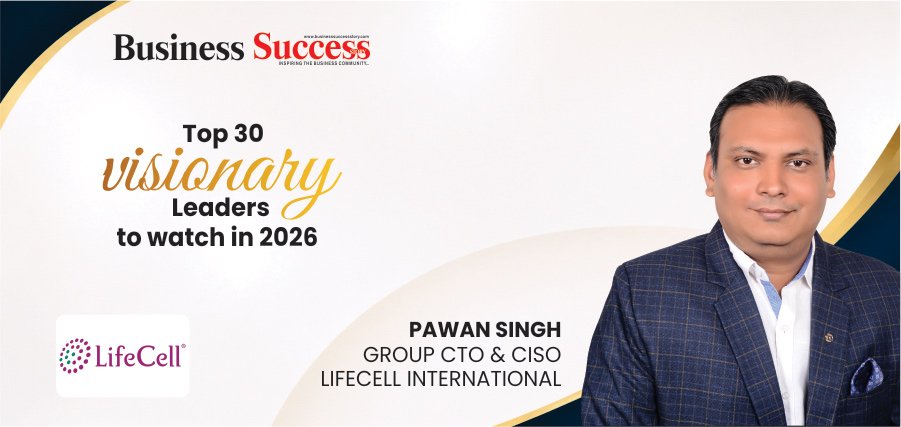
Pawan Singh, Group CTO & CISO at LifeCell International, is a technology and business leader whose influence extends well beyond the traditional boundaries of technology. With over two decades of experience across health-tech and life sciences, he has built a career around a distinctive vision: bringing technology, business strategy and people together to create meaningful and sustainable organisational impact.
At LifeCell International, he has played a pivotal role in shaping the group’s digital and business architecture, enabling its diverse healthcare businesses to evolve, scale and embrace innovation. His leadership spans key business verticals, including LifeCell’s Diagnostics and Biobanking businesses, the MFine digital healthcare platform, AreoVeda’s consumer skincare business and Cellution Biologics’ regenerative wound-care initiatives.
What distinguishes his journey is his ability to connect emerging technologies with real-world business opportunities. From advancing digital healthcare and teleconsultation to enabling innovation in stem cell science, consumer wellness and advanced tissue therapeutics, his contributions reflect a broader commitment to transforming how healthcare is delivered, experienced and scaled.
For Pawan, technology is not merely an enabler or a support function; it is a strategic force that can reshape businesses, empower people and unlock new possibilities. His leadership philosophy centres on building future-ready organisations where innovation, operational excellence and business vision move forward together.
Leading Across New Frontiers
“My leadership journey has been an evolution rather than a destination. I started my career with a strong focus on technology, systems, and execution,” says Pawan. Early in his career, he had an appetite for solving technical problems well. As his responsibilities grew to include operations, customer experience, and business growth, he realized that technology alone does not transform a business. Culture, people and a genuine understanding of the customer do the heavier lifting, with technology as the accelerant rather than the engine.
His shifting perspective reflects the company’s diversification. From cord-blood preservation to digital consultations, skincare and wound-care biologics, the company has broken new ground with every new vertical. He treats each business not just as an innovative extension but as a distinct ecosystem with its own customers, risks and rhythms. He combines technology, data, and innovation to create meaningful business outcomes.
Leadership Without the Bottleneck
The true essence of leadership has nothing to do with title. It is the ability to bring like-minded people together to solve a problem, instead of letting them shoulder everything alone. That belief has shaped his leadership style. Early in his career, he admits to being deeply hands-on, convinced that proximity to every decision was the price of quality. With time and experience, however, he realized that leadership encourages ownership rather than dependency.
His leadership style is deliberate yet empowering. He sets clear expectations and provides direction while giving people the freedom to determine the best way to achieve the desired outcomes. “I remain hands-on when the situation requires it, but I consciously try not to become the bottleneck,” adds Pawan. This leadership style trades the comfort of control for something more enduring: a team capable of thinking, making decisions and moving forward even when the leader is not in the room.
The Framework of His Leadership
Strong principles are the foundation of any leadership. Pawan’s leadership is underpinned by integrity, ownership, customer impact, speed, continuous learning, and respect for people. Among these, ownership and speed play an important role in his decision-making. He believes problems require people to step forward and take responsibility, while decisions often need to be made without waiting for perfect information.
A good example is his experience in driving transformation across legacy systems, processes, and teams. During his two-decade stint, he learned that even the best technology cannot create change unless people adopt it. Since then, he has looked beyond whether a technology has been implemented and focused more on whether it has actually changed the way the organisation works. This demonstrates an important element of his leadership. It is the ability to find the right balance between acting decisively while remaining mindful of the consequences. His ability to combine ownership with sound judgment allows him to be deliberate during complex decisions.
Nurturing Leaders, Building Teams
As passionate as Pawan is about leadership, he is deeply invested in empowering next-gen leaders. His mentorship is centred on one goal: helping people become capable of leading independently. Instead of giving immediate answers, he encourages people to think through problems themselves. He further adds, “I also encourage young leaders to develop three capabilities simultaneously: business understanding, technology depth and people leadership.” Strong skills in only one area can eventually limit a leader’s impact.
His approach to mentorship has helped him build a team that knows how to respond when circumstances change, make decisions when the path is unclear, and keep moving when challenges arise. Pawan values different perspectives and believes people should feel comfortable expressing views that challenge his own. “A strong team should not consist of people who always agree with the leader,” says Pawan. For him, constructive disagreement is not a weakness. It is often a sign of a team that feels confident enough to think independently.
Creating a Legacy to Look Back On
For Pawan, success as a leader goes beyond financial performance. He also looks at whether the teams have grown stronger, future leaders have emerged, and the organisation has built capabilities that continue to create value. He weighs his impact by the strength of the teams he has built, the leaders he has developed, and whether the systems he leaves behind continue to function without depending on any single person, including himself. Watching someone he has mentored take on greater responsibility and succeed, he says, remains among the most satisfying markers of a leadership career.
Perhaps the clearest understand of Pawan’s philosophy is how he thinks about what should outlast him. Not a title. Not a list of projects, however significant. He hopes to be remembered as someone who helped organizations become more digital, more data-driven, and more genuinely customer-centric. But the achievement he values most is far more personal. He seeks to see people who worked alongside him becoming better leaders.
As the health-tech sector evolves rapidly and technology changes faster than strategies can keep pace, Pawan’s view of achievement remains rooted in something more enduring. For him, the most meaningful measure of leadership is not simply what a leader builds, but whether the people around them become more capable, confident, and prepared to lead themselves.