What separates a visionary from a simple business leader?
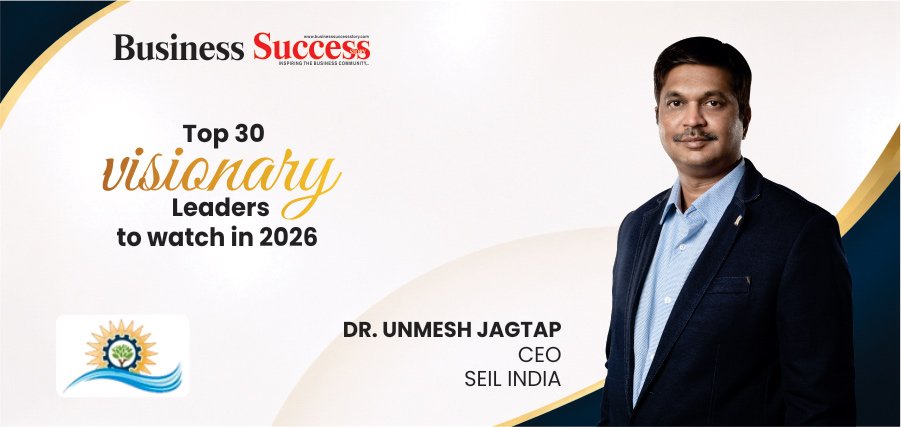
The ambition, the intelligence, and the willingness- all of them are important. But the defining difference is foresight. The ability to value an opportunity where others see uncertainty, and to commit to unlocking its potential – that’s what makes them trendsetters. They shape industries instead of simply participating in them. Long before clean energy became one of the biggest trends, or solar energy turned into one of the fastest-growing industries, Unmesh Jagtap was already immersed in building his future around it.
While the country was yet to realize the potential of solar, it was clear to Unmesh that the future depended on cleaner and more efficient sources of power. What began as curiosity gradually evolved into a lifelong mission to advance energy conversion, renewable technologies and sustainable infrastructure. Today, as CEO of SEIL India, Dr. Unmesh is leading an organization that has grown alongside India’s transition to clean energy. Under his guidance, SEIL India is setting trends in engineering excellence and technological advancement around solar infrastructure.
The Decision That Changed Everything
In 1996, Unmesh was fresh out of a Master’s Degree at the University of Florida. During this time, he advanced his research under Dr. Yogi Goswami, a revered scientist in solar energy with over 19 patents and also the brain behind the Goswami thermodynamic cycle. It was the kind of resume that could have kept him in the USA indefinitely. Instead, he boarded a flight to India and chose to join his family business. His father, Late Mr. Balasaheb Jagtap, had a 500 sq.ft. workshop where he spent his days cutting precision engine parts for Kirloskar and Cummins.
His father had built that workshop from nothing. He had spent 15 years in Kirloskar Oil Engines, rising from draftsman to tool-room in-charge, before striking out by himself in 1975. By the time Unmesh returned, that shop evolved into a CNC operation trusted by Kirloskar, Cummins, and Mahindra. The work, exacting as it was, taught him the discipline required to run a business and the importance of reputation.
Fast-forward to the 2000s, and solar was still at a formative stage in India. However, renewable energy was already moving from laboratories to commercial applications in other parts of the world. Where many saw an emerging industry, Unmesh saw an opportunity to combine engineering precision with research in solar energy. That laid the foundation of SEIL India. Rather than launching a conventional EPC business, he envisioned an organization capable of delivering technically robust, long-lasting energy solutions.
Building a Market, Not Just a Business
When Unmesh stepped into solar space, customers questioned his viability, investors were cautious about unfamiliar technologies, and every proposal demanded as much education as engineering. Yet, he was constantly encouraged by two people who told him to look beyond the present. “My mentor, Dr. Goswami, constantly encouraged me to contribute to India’s transition to clean energy, which inspired me to diversify into the solar energy sector,” he says. A second mentor, Bipin Shah, a board member who had consulted for the US Department of Energy, further introduced him to technologies unheard of in India, like smart power optimizer and reflective cool paints.
Rather than replicating what already existed, Unmesh wanted to bring global best practices to India’s emerging solar industry. As the company expanded, so did his ambitions. From rooftop solar installations, they expanded to large industrial and ground-mounted projects, serving clients across India and international markets. While every project had engineering, regulatory, and operational complexities, each successful project reinforced SEIL India’s position in the Indian market. Along with technical expertise, the company’s reliability earned a reputation for its trust, collaboration, and ability to align diverse stakeholders behind a common objective.
Conviction Put to The Test
Every visionary eventually reaches a defining moment that tests not just their expertise but their character too. For Unmesh, that moment arrived in 2024. The team was assigned to integrate a 4.5 MW solar power system into a German manufacturing facility, working around the clock. Shutting down production wasn’t an option. Every phase of execution had to be meticulously planned, redesigned where necessary, and coordinated. With stakeholders spread across India and Europe, tight contractual timelines, and virtually no room for error, the project demanded precision far beyond engineering calculations.
As the team accomplished the task, Dr. Unmesh learned something important: “Technology alone does not deliver successful projects. People, trust, collaboration, and effective communication do.” The philosophy has become a core pillar across SEIL India’s operations. Every project, irrespective of size and shape, is treated as a sustainable relationship rather than a transactional engagement.
Every Partnership, A 25-Year Promise
For most companies, a client relationship concludes with the project handover. At SEIL India, it marks the beginning of a twenty-five-year commitment. “The solar project life is 25-plus years,” Unmesh continues, “So we have a philosophy that whenever we hand over any project to our client, we are giving him a commitment of 25 years.” This fundamentally changes the relationship between the company and its customers.
At the same time, it shapes how the company treats the people who build it. Employees are seen as stakeholders. When a project ends with extra financial gains through smarter procurement or sharper negotiation, those gains are shared out across the team. The approach has helped the company navigate volatile markets, fluctuating module prices, and supply-chain disruptions without compromising on quality or client commitments. It is this kind of partnership that helps them maintain relationships that would still matter decades later.
Empowering the Next Generation
Dr. Unmesh’s leadership and his company have evolved visibly over time. During the company’s early years, Unmesh was the one finding solutions, educating clients, and pushing projects across the line. With time, the business grew, and the trajectory required a different mindset. He invested in building another panel of leadership, freeing him to focus on technology, design, and strategy. His wife Ashwini took over procurement negotiations and client relationships. This gives him the room to concentrate on research and innovation.
With such structures in place, Unmesh’s focus has shifted to enabling people. “The CEO’s role is to establish the vision, remove obstacles for the team, and create opportunities for people to excel,” he says. It allows him to mentor the next generation inside the company. He encourages them to embrace complex challenges, think beyond functional boundaries, and make decisions with confidence. After all, as Dr. Unmesh puts it, “Titles do not create leaders, actions do.”
Building a Legacy Beyond Business
From researching solar energy to helping shape one of India’s fastest-growing industries, Dr. Unmesh’s journey exemplifies what it truly means to be a visionary. For him, the true measure of success extends well beyond financial performance. It is reflected in the renewable energy capacity created, the carbon emissions reduced, the future leaders developed, and the lasting relationships forged with clients.
However, the journey has never been about building a successful company alone. It is about building an institution that advances India’s clean energy transition and empowers the next generation of leaders. In the end, his legacy will be measured not just in megawatts generated, but in the future he helped shape.