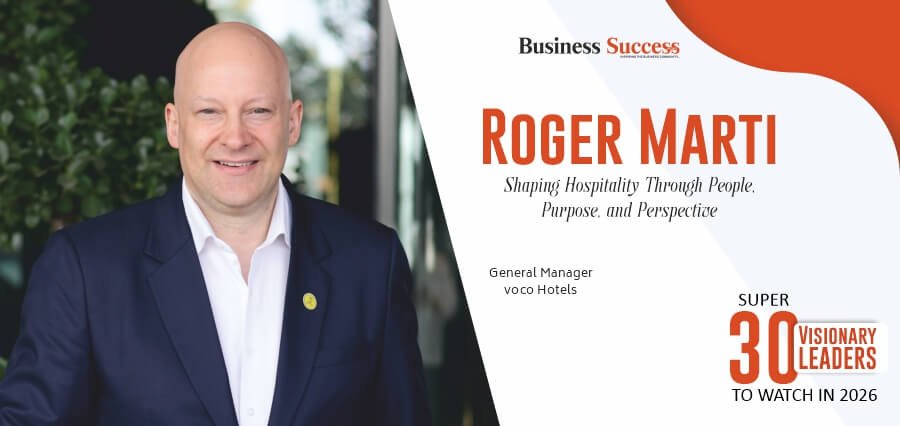
Long before leadership became a title Roger Marti chose to develop the viewpoint of leadership. The global hospitality industry became his professional path because he developed his skills through observing people and learning to adapt while maintaining his dedication to others. He started his career at Hyatt Hotels but he discovered that hospitality leadership requires more than operational skills because it depends on building relationships and understanding different cultures.
His leadership capacity to handle numerous team types improved through his time spent in eleven different countries which helped him develop better work methods. The General Manager position at Voco Hotels provides him with a liberty to combine his extensive international experience with his fundamental leadership values which he developed through humble dedication to active work. The proof of his career demonstrates that effective leadership requires more than power because leaders should inspire their teams while empowering their members to develop their skills.
Learning the Game from the Ground Up
When Roger joined Hyatt Hotels at the outset of his professional career, he arrived with both ambition and a sharply observant eye. He noticed quickly that the leaders who rose furthest were not always the ones with the most refined technical skills, they were the ones who understood people. He watched F&B professionals transition into management roles. He saw Executive Chefs reach the rank of General Manager. These were not anomalies to him. They were proof of concept.
That early observation crystallized something important: in hospitality, the path to the top runs directly through the people you serve alongside, not above. He absorbed this truth early, and it shaped every decision that followed. He pursued roles that would challenge him across geographies, immersing himself in cultures where his assumptions were tested and his adaptability sharpened. Eleven countries. Each one has a masterclass. Not even one redundant.
Humility as a Leadership Instrument
Ask Roger how he defines his leadership style, and he does not reach for the expected vocabulary of disruption or transformation. He reaches for something quieter, and arguably more powerful: humility. He has always advocated for a humble approach, he says, with the measured calm of someone who has seen both kinds of leaders, the ones who listen and the ones who don’t.
Leading by example remains the cornerstone of his approach. He does not ask his teams to embody standards he himself does not model. He steps into work, rolls up his sleeves, and makes himself present, not as a figurehead, but as a collaborator. For Roger, the distance between a leader and their team should be measured not in hierarchy but in trust.
His core values read like a well-constructed manifesto: integrity, accountability, respect, excellence, collaboration, innovation, customer focus, sustainability, empowerment, and adaptability. But what makes them meaningful is that he does not treat them as aspirational wall art. He treats them as operational tools decision-making filters that get applied in real-time, in difficult moments, with real consequences.
“In contemporary times, I firmly believe that laziness is no longer a viable support system. Individuals are expected to demonstrate a strong work ethic and unwavering commitment,” he says.
Leading Through Uncertainty
No leadership story worth telling lacks a crucible moment, a period of pressure that strips away posture and reveals character. For Roger, that moment arrived during a stretch of significant organizational change and uncertainty. The kind of change that makes even seasoned professionals question the ground beneath them.
He did not respond by issuing directives or doubling down on process. He responded by communicating relentlessly, transparently, and with genuine empathy. He held open dialogues. He listened to concerns without deflecting them. He addressed individual fears while keeping the collective focused on what lay ahead. The result was not a team that survived the transition. It was a team that emerged from it stronger, more cohesive, and more trusting of the leadership that had steadied them.
This approach communication first always mirrors the broader philosophy he applies to balancing strategic vision with day-to-day leadership demands. He schedules deliberate time for long-range thinking. He delegates with intention, trusting his team members with meaningful ownership rather than administrative triviality. He reviews progress against strategic goals regularly, recalibrating, when necessary, without losing sight of the horizon.
Creating Cultures That Dare to Imagine
In Roger’s world, innovation is not a department. It is a disposition. He actively fosters environments where team members feel safe enough to experiment, to propose the unconventional, and yes to fail productively. He champions a growth mindset that reframes failure not as a verdict but as data: valuable, teachable, and worth the risk.
He backs this culture with action. He provides tangible resources for innovation like training programs, recognition for creative contributions, and the structural space for diverse perspectives to collide and generate something new. He leads from the front here too, consistently modelling curiosity, seeking feedback on his own approaches, and refusing to let institutional inertia calcify what works into what always must be.
This emphasis on inclusivity extends well beyond innovation strategy. He actively builds diverse teams, not as a compliance exercise but as a competitive advantage. He actively seeks out varied candidates during recruitment, invests in diversity training, and constructs communication environments where every voice, particularly those that have historically gone unheard carries genuine weight.
The Mentor Within the Manager
Mentorship, for Roger, is not a formal program entry in a company handbook. It is the lived practice of investing in someone else’s growth with the same seriousness you bring to your own. He builds mentoring relationships on trust, holds space for honest conversation, and offers the kind of feedback that challenges without diminishing.
To the next generation of hospitality leaders, his advice is both practical and motivational. He urges them to embrace continuous learning as a non-negotiable professional habit, to build relationships with intentionality, and to lead with the authenticity that comes from genuinely knowing who you are under pressure. “Resilience is not a personality trait you either have or don’t. It is a muscle. You build it through reps through challenges met, setbacks absorbed, and mornings where you choose to show up anyway,” he emphasizes.
Success Beyond the Bottom Line
When Roger evaluates his performance as a leader, he does not begin with P&L statements or RevPAR metrics, he begins with people. He closely examines how engaged his teams are, whether they are growing, and if the environment he has cultivated genuinely values diverse perspectives. For him, success also lies in maintaining clear, two-way communication, not just top-down directives, but open channels that encourage honest, upward feedback. At the same time, he is deeply driven by a pursuit of perfection, consistently aiming to operate at a number one standard rather than settling for second-best. He believes that a culture rooted in motivation, positivity, and high standards is essential to delivering exceptional results.
Equally important is the way he turns the lens inward. Personal growth, self-reflection, and continuous learning are integral to his leadership approach. He sets clear goals, manages his time with discipline, and develops his emotional intelligence with the same rigor he applies to strategic decisions. Feedback, for Roger, is not a formality but a vital tool for refinement, fueling his constant pursuit of excellence and reinforcing his commitment to lead with both precision and purpose.
A Legacy Written in People, Not Plaques
Ask Roger what legacy he hopes to leave, and he sidesteps the language of monuments entirely. He wants to be remembered as someone who inspired others to reach for more. Someone who empowered his teams to grow, took the time to mentor the next generation of leaders, and built environments where inclusion was not a talking point but a daily reality.
He wants the people who worked alongside him to look back and say that he led with compassion that he saw them not as resources to optimize but as human beings to invest in. That he built real trust, fostered real collaboration, and left every team, every property, every organization measurably better than he found it.
Across eleven countries, Roger Marti has carried the same essential conviction: that context changes, cultures differ, and markets shift but the fundamentals of great leadership do not. Humility. Integrity. Presence. Care. These are not values that expire when the environment evolves. They are the ones that endure precisely because they do not.