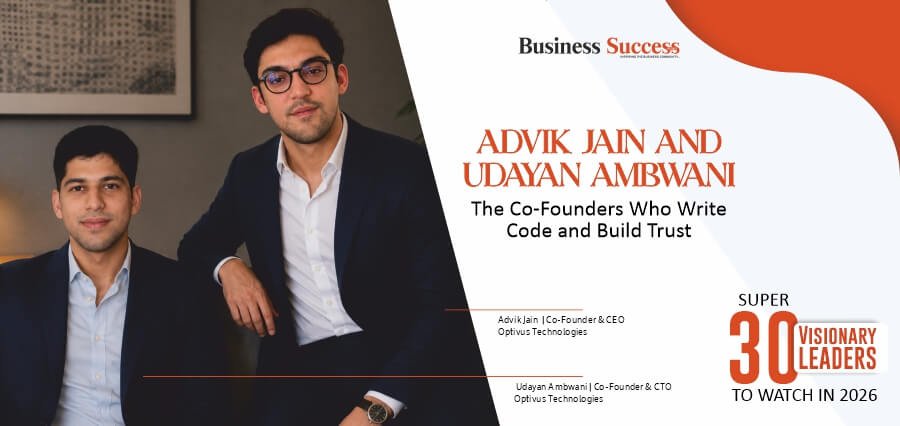
In an industry saturated with strategy decks, polished presentations, and promises of transformation that rarely survive first contact with reality, building something that actually works and keeps working demands a rare combination of technical conviction, leadership courage, and the willingness to stay in the room long after most have taken their fees and left. The artificial intelligence sector, for all its explosive promise, has become a graveyard of brilliant pilots that never reached production, of enterprise clients who paid handsomely for notebooks and slide decks but never saw a system run at scale. The consultants moved on. The problems remained. It was into this very gap, frustrating, costly, and largely ignored, that Advik Jain stepped with a clear thesis and no intention of repeating the cycle he had watched play out too many times. As Co-Founder and CEO of Optivus Technologies, founded in April 2025, he set out to answer the question the AI industry had been sidestepping for years: what does it actually look like to deliver enterprise AI that survives in production? The Super 30 Visionary Leaders to Watch in 2026 recognizes Advik Jain as one of the most compelling answers to that question.
Built From Frustration, Not Theory
Advik Jain did not arrive at leadership through a management programme or a strategic career plan. He arrived through years of proximity to a pattern he found genuinely unacceptable. Embedded in enterprise technology teams before founding Optivus Technologies, he watched consistently as AI consulting partners produced strategy work, ran pilots, and walked away before a system ever reached production. The client was left with documentation and debt. The cycle repeated with the next partner.
He mentions, “We had spent years watching enterprise clients waste budgets on AI partners who could produce a deck but could not deliver a system, and we decided someone had to do it differently.” That decision, to do it differently, became the entire foundation of Optivus Technologies. The company launched in April 2025 with a contrarian but precise thesis: production discipline over consulting polish, working systems over impressive artifacts, long-term partnership over short-term margin.
What followed was not slow. By the end of 2025, Optivus Technologies had deployed Janus, an AI recruiting platform running at scale; Veritas, powering enterprise marketing workflows; and, early into 2026, Flowfin, processing thousands of invoices end-to-end for clients. Each system became proof of concept not just for the client, but for the broader market.
Builder-Led, by Design
The leadership style Advik practices at Optivus is not accidental; it is a direct response to everything he found broken about the firms he had observed. He and Udayan Ambwani, Optivus Co-founder & CTO, made a founding decision that both would continue writing production code. There would be no separation between leadership and the actual engineering work.
He states, “Every engineer on our team sees the founders making the same calls about queues and retries and reconciliation logic that they make. No class of work is below a leader at Optivus Technologies.” That philosophy removes hierarchy-driven politics and keeps the organisation oriented toward what actually matters: systems that work and clients who trust them.
The approach extends to how the team is structured and motivated. Engineers at Optivus Technologies own systems end-to-end, from architecture through deployment to the on-call rotation that follows. According to him, “The strongest motivation in a small senior team is ownership.” Advik does not separate the people who design from those who build from those who operate. That integration of responsibility produces engineers who take the work personally because it genuinely is theirs.
A Thesis That Compounds
When Optivus Technologies entered the market in 2025, the biggest challenge was not technological; it was credibility. Enterprise buyers had been burned before, and a young firm with a contrarian position had to earn trust that words alone could not deliver. Jain’s response was characteristically direct. He states, “When the market is skeptical, do not argue louder. Build something the market can verify.”
Every client conversation began with a production system, not a pitch. The systems carried the argument. That approach has shaped a reputation that now draws former colleagues and senior engineers toward Optivus Technologies professionals who know the work from the inside and choose it anyway.
Looking ahead, Advik Jain carries a vision that extends well beyond Optivus Technologies itself. He hopes to demonstrate that an Indian-founded, founder-led firm can set the global standard for what production AI looks like, shifting India’s AI services narrative from decades of price arbitrage toward genuine technical leadership. According to him, “India’s AI services industry has been a price-arbitrage story for thirty years. We would like to help write a different chapter.”
That chapter, built one production system at a time, is already underway.